Why a Shared Table Changes the Shape of a Conversation
Shared table conversation depends on more than seating: use the table’s centre, edges and shared objects to give people natural ways to connect.
At a neighbourhood repair evening, a tin of spare buttons can draw people into conversation more naturally than a carefully arranged row of chairs. Shared table conversation often grows from what people do together: sorting, making, passing or explaining something. Design the table around that shared activity, and it can become a useful meeting point rather than simply a place to sit.
This approach suits a community room, library workshop or courtyard gathering. Choose one modest activity that fits the group, give shared materials a clear purpose and leave room for people to take part in their own way. The table’s role is not to force conversation, but to offer people something easy to notice and respond to.
Give the table a shared purpose
A table feels more welcoming when people can tell what it is for. A stack of unlabelled papers may look like administration; the same papers with a clear question can invite people to add an idea. Shared food, a map or a simple making activity can also provide a natural starting point.
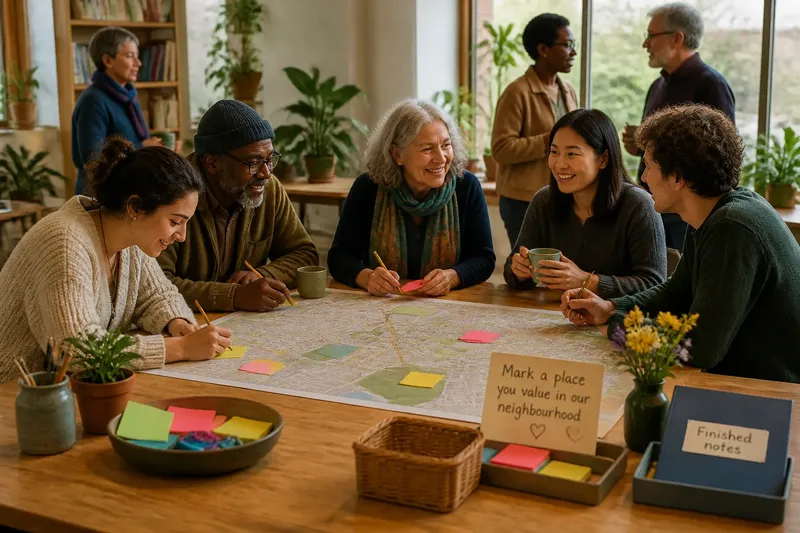
Pick an activity that does not demand a particular skill or a long explanation. For example, put a street map and a few sticky notes on the table, then invite people to mark a place they value. Keep the invitation optional. Someone may prefer to listen, look at the map or talk with a neighbour rather than write.
Make the shared purpose visible with a short handwritten note or a spoken explanation. If people are unsure whether an item is for everyone, clarify it before they have to ask. That small cue can turn an object into a shared resource rather than a barrier.
Use shared objects to create small openings
Objects give people a reason to speak without requiring an elaborate introduction. Passing a bowl, comparing notes on a local map or choosing a song for a community playlist can prompt an exchange that starts with the activity itself.
Choose objects that are easy to handle and simple to return. A communal pot of tea needs cups and a clear place to put used ones; a map activity needs pens that work and notes that can be moved. Avoid filling the surface with props that compete for attention. One main activity is usually easier to understand than several unrelated ones.
Say you are hosting an invented neighbourhood seed-sorting afternoon with a tin of labelled seed packets, small envelopes and pencils. Put one packet type at a time on the table, invite people to sort or label envelopes, and explain that watching is welcome too. The expected result is a visible shared task that can prompt practical conversation, while participants choose how much to do.
Leave room for different ways of taking part
Participation does not have to mean speaking to the whole group or completing a task. Someone might read a label aloud, pass materials, listen to a story or simply stay nearby. Make these options plain so the activity does not become an unspoken test of confidence.
Offer materials in a way that makes their use clear. Put spare pencils beside the map, keep finished notes in a labelled tray and explain whether people may take their work home. If the activity involves personal stories or sensitive details, let participants choose what they share and avoid recording anything without their permission.
Watch for confusion rather than judging people’s enthusiasm. If several participants pause before using an item, explain the next action in one sentence. If people begin adapting the activity themselves, let that develop unless it excludes someone or changes the agreed purpose.
Choose a table activity that fits the gathering?
What works for people who have just met?
Use a shared task with an obvious first move, such as adding a note to a local map or sorting materials by colour. It gives newcomers something to do without asking them to disclose personal details.
How can a table activity include quiet participants?
Offer a way to join without speaking, such as placing a mark, choosing an item or observing. Explain that each option counts as taking part, and do not call on someone to perform.
What if the group wants to talk instead?
Keep the activity available but pause it if conversation takes over. The table has served its purpose if it helped people connect, even when the planned task stops.
How do I know if an activity is too complicated?
If people repeatedly ask what to do next, reduce the instructions to one clear action. Put away any materials that are not needed and explain the activity again in plain language.
Use a quick check to decide what to change
Before the gathering, check the activity and the materials as well as the table itself. For each observation, make a practical decision rather than adding more decoration or instructions by default.
- If the purpose is not clear from the materials, add a short note explaining the first action; if the note would make the activity feel compulsory, explain that taking part is optional instead.
- If an object is difficult to use or return, replace it with a simpler one; if no replacement is available, demonstrate its use and keep it within easy reach.
- If several activities compete for attention, remove all but the one that best fits the gathering; if guests need different options, place the alternatives on separate surfaces.
- If people cannot tell where finished work belongs, label a tray or folder; if the work is personal, let participants keep it rather than collecting it.
- If materials invite people to share private information, change the prompt to something non-sensitive; if the activity still depends on disclosure, choose another activity.
- If a participant appears unsure how to join, offer a quiet explanation or an observing role; if they decline, leave the choice open without pressing them.
Imagine a fictional library group planning a local-memory afternoon. The starting materials are a printed street map, sticky notes and pencils; the intended task is to mark places people remember fondly. The organiser first notices that the map has no prompt, so they add a note asking guests to mark a place they wish to share. They then see that some notes could name private homes, so they revise the prompt to ask for public places instead. Finally, they label a folder for finished notes and say that anyone may observe without writing. The resulting plan gives the group a clear activity while avoiding a request for personal addresses; its trade-off is that individual home stories are less likely to be recorded.
Keep shared table conversation easy to enter
After the gathering, notice which materials people used and which instructions caused hesitation. Keep the parts that gave participants a clear way to connect; remove props or prompts that made the activity harder to understand. A short note for the next host can capture what to bring and what to explain.
Shared table conversation works best when a common object or task offers an opening, not an obligation. Choose one clear purpose, make the first action easy to understand and leave people free to contribute in different ways. That gives the table a useful role in local life, whether the group is sorting seeds, marking a map or sharing tea.