The Open Invitation Myth: Why an Invite Can Still Feel Hard to Join
Make an open invitation easier to accept by clarifying the activity, expectations and choices, so newcomers can decide whether it suits them before they arrive.
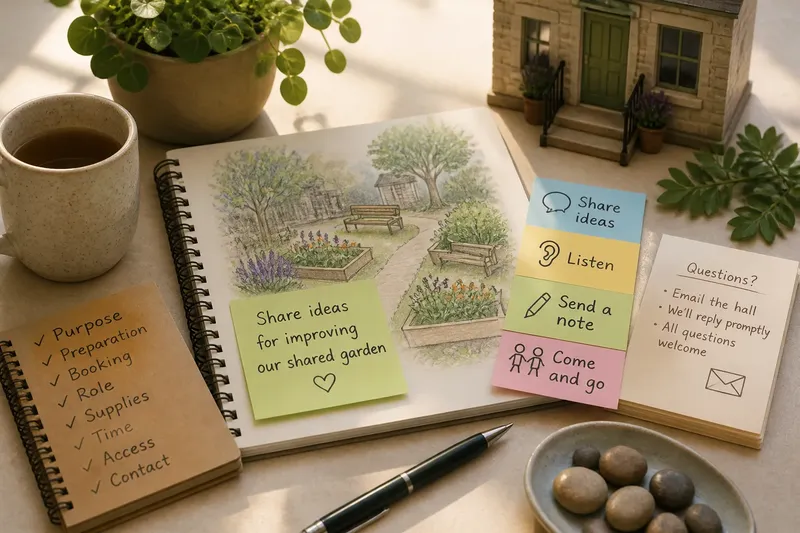
An open invitation is easier to accept when it tells people what they are being invited to do. “Everyone welcome” may sound friendly, but it does not say whether the gathering is a planning meeting, a shared activity or a request for volunteers. Add a clear purpose and people can decide whether the event fits them.
Before publishing an invitation, look for the decisions a newcomer would have to make: whether to prepare, whether to contribute, and whether the gathering is for them. You do not need to anticipate every question. Clarify the choices that are specific to this event, and avoid treating attendance as a promise to take on a role.
Say what the gathering is for
Use a concrete description rather than a broad label. “Neighbourhood craft evening” gives a reader a starting point; “community event” does not explain what people will spend their time doing. Add the purpose if it is not obvious, such as making decorations for a local celebration or sharing ideas for a community garden.
Be plain about what people may be asked to do. If the group will discuss a proposal, say so. If the activity is simply an opportunity to meet neighbours, do not imply that attendees must help organise future events. A clear invitation lets people judge the event on its actual terms.
Say you are arranging an informal garden planning session. The draft reads, “Come and help us improve the green space.” You change it to, “Bring ideas for the garden beds; the session is for sharing suggestions, and there is no planting task planned.” Readers can then distinguish a discussion from a work party and decide which one they want to attend.
Make preparation and contribution explicit
State whether people need to bring something, book ahead or sign up for a task. If no preparation is needed, say that too. Do not let a cheerful invitation conceal an expectation to bring food, supplies or specialist knowledge.
When help is requested, describe the task and whether it is optional. “We need volunteers” leaves the commitment unclear. “We could use help arranging chairs before the talk; attending without helping is also welcome” gives people a choice they can understand.
- Check the purpose: If the notice names only a broad theme, add the actual activity; otherwise, keep the description short.
- Check preparation: If attendees must bring or read something, name it; if not, say no preparation is needed.
- Check booking: If people need to reserve a place, explain how; if they do not, say that drop-ins are welcome.
- Check the role: If help is requested, name the task and whether it is optional; if no help is needed, avoid wording that suggests a duty.
- Check supplies: If participants need their own materials, list them; if materials are provided, state that plainly.
- Check the time commitment: If the event has a fixed session or a useful point to arrive, state it; if people can come and go, explain that instead.
Offer participation choices that belong to this event
Participation does not have to mean speaking in front of a group, but alternatives should be real rather than decorative. For a listening session, people might contribute a comment, submit a note or listen without speaking. For a planning meeting, those options may not fit; explain what the meeting requires instead.
Keep the invitation’s options manageable. A long menu of hypothetical roles can make a simple gathering sound like a shift rota. Include only choices the organisers can support, and say clearly if a task requires a commitment beyond attending.
Give newcomers a useful way to ask
Some questions are too specific to answer in a general notice. Provide a contact route that suits the audience, such as an email address, telephone number or named contact at the community centre. If an event is advertised through a social media group, include a way to ask without joining the group where possible.
Share access information you can confirm, including the venue entrance, seating arrangements and any known limits. Invite people to ask about details that are not covered, without asking them to explain personal circumstances in public. If you are unsure about a venue detail, check with the organiser before publishing rather than guessing.
How should you check an invitation before sharing it?
What information belongs in a short invitation?
Include the event’s purpose, date, place, activity and any preparation or booking requirement. Add a contact route if someone may need to ask about a detail before deciding.
How can you say that help is optional?
Name the task and state that attending without doing it is welcome, if that is true. If a role is required, explain the commitment before people sign up.
What if the event has a firm limit?
State the limit plainly, such as a booking requirement or a task that needs advance preparation. If you know of a suitable alternative, point to it without implying that it is identical.
How can you tell whether the wording is clear?
Ask someone unfamiliar with the event to identify its purpose, what they need to do beforehand and whether they are expected to help. If they cannot answer from the notice, add the missing detail rather than padding it with general reassurance.
Work through the invitation using its actual details
Imagine a local residents’ group is planning a notice for a community-hall session about improving a shared garden. The organisers’ hypothetical starting details are: discussion only, no booking, no materials required, optional suggestions from attendees and a venue entrance that they have confirmed with the hall. They do not yet know whether the room has step-free access.
- Write the purpose as “Share ideas for improving the shared garden” rather than “Help us make a better neighbourhood”. The resulting notice identifies a discussion, not a work session.
- State that attendees do not need to bring tools or prepare ideas in advance. The decision is clear: people can come without supplies or homework.
- Say that suggestions are welcome but nobody is assigned a task. A reader can decide whether they want to speak, listen or simply find out what is being discussed.
- Add the confirmed entrance and the hall’s email address for questions. The invitation gives newcomers a way to check details without relying on local knowledge.
- Leave step-free access unanswered in the draft and ask the hall to confirm it before making a claim. Until then, the organisers can include the email address and invite access questions; they should not describe the venue as accessible without confirmation.
The resulting invitation is specific about the activity and honest about what remains uncertain. Its trade-off is that it cannot yet answer every access question, but it avoids misleading anyone and provides a direct way to ask.
State limits without disguising them
A gathering may require advance booking, a particular level of commitment or materials that organisers cannot provide. Put that limit in the invitation, not in a later message after someone has decided to attend. Keep the explanation brief and offer another option only if one genuinely exists.
Check practical details with the venue or event organiser before sharing them, especially when access arrangements or booking conditions are unclear. A candid limit helps people choose; a vague welcome followed by an unexpected condition makes that choice harder.
For an open invitation, the most useful final edit is often a specific noun or sentence: name the activity, the preparation or the optional task. Use the main phrase, “open invitation”, as a prompt to check whether the words explain what joining actually involves. Warmth matters, but clear choices are what let a reader decide.